
1912 Sport and art, an abandoned experiment
From 1912 to 1948, the Olympic Games awarded medals for art in five fields. The International Olympic Committee (IOC) ended these competitions in 1949. The lesson the Olymp’Arts draw from this: art needs its own olympiad, held at a different time from sport.
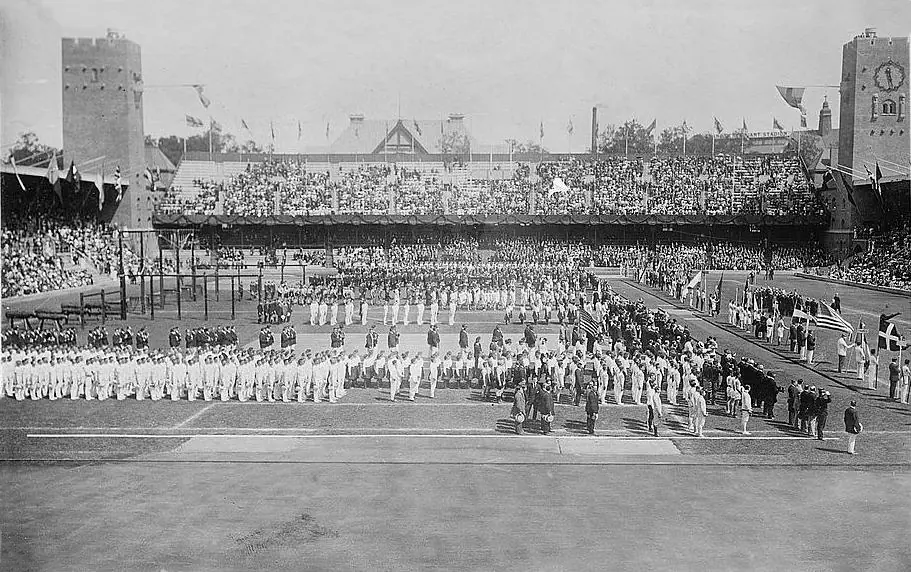 (enlarge image, opens in a new tab)
From 1894 to 1948: Coubertin’s dream, seven attempts
In 1894, Pierre de Coubertin founded the International Olympic Committee and revived the Olympic Games; he dreamed of bringing art into them, but he did not know of the initiative of the ancient Greeks, who had created the arts olympiads in 566 BC. Indeed, the book by historian Nicolaos Yalouris that revealed this initiative was only published in New York in 1979.
This is one of the reasons why the first modern arts olympiad, in 2027, will be held in tribute to Pierre de Coubertin, whose dream will at last come true.
Because of this lack of knowledge, seven attempts were made between 1912 and 1948.
All of them failed, for the reasons set out below.
1949: the IOC ends the art competitions
Finally, following a report presented in Rome in 1949, the IOC abolished the art competitions. One of the reasons given was the conflict with the amateur spirit of Olympism, since the artists taking part were well-known artists.
Since 1956: cultural programmes, without competition
The competitions were replaced by exhibitions and then, from 1956, by cultural events organised freely by each host country. No medals are awarded.
Why sport and art cannot be judged together
For Marc Verrière, four reasons make the two fields incompatible within the same olympiad.
Sport is measured; art is felt. A stopwatch or a score separates athletes; a work of art is judged on the harmony and emotion it creates.
Art is a subjective field that calls on the creativity of the mind, and can bring artists with disabilities together in the same olympiad, whereas sport, which is objective, measures the performance of the body with unavoidable discrimination.
The Olymp’Arts aim to reveal talented artists who are still unknown and lack the means to make themselves known.
The artistic performances staged around the sporting games are chosen arbitrarily to promote the host country.
1994: Nelson Paillou’s view
In his letter of 6 April 1994, President Nelson Paillou approved this separation of art and sport, because past failures had proved them incompatible.
Hence the Olymp’Arts’ offset calendar
As art and sport cannot come together in the same olympiad, the founder based the legitimacy of his initiative on respecting the offset calendar of ancient Greece.
Sources
- International Olympic Committee, “Look to the past: When Olympic medals were awarded for architecture, music and literature”, olympics.com, 22 October 2021 (external site, opens in a new tab).
- Nicolaos Yalouris (ed.), The Eternal Olympics: The Art and History of Sport, Caratzas Brothers, 1979 (see the 566 BC page).
- Richard Stanton, The Forgotten Olympic Art Competitions, Trafford, 2000.
- Letter from Nelson Paillou to Marc Verrière, 6 April 1994, Marc Verrière archives.