
1995 The Olympic Arts Charter signed at UNESCO
On 10 and 11 July 1995, at UNESCO in Paris, cultural figures from 65 countries signed the first Charter of the modern Olympic Arts, on the initiative of Marc Verrière. A year earlier, Nelson Paillou, President of the Centennial Congress of the International Olympic Committee – Paris 1994, had written to him: “I fully support your charter”
.
10 and 11 July 1995 at UNESCO
 (enlarge image, opens in a new tab)
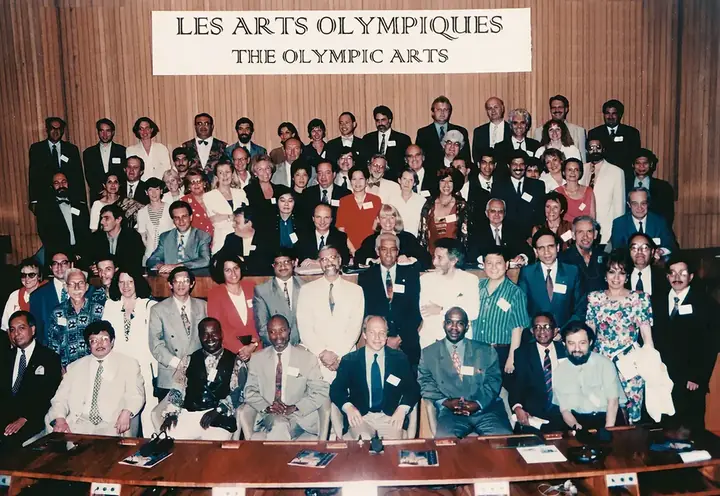
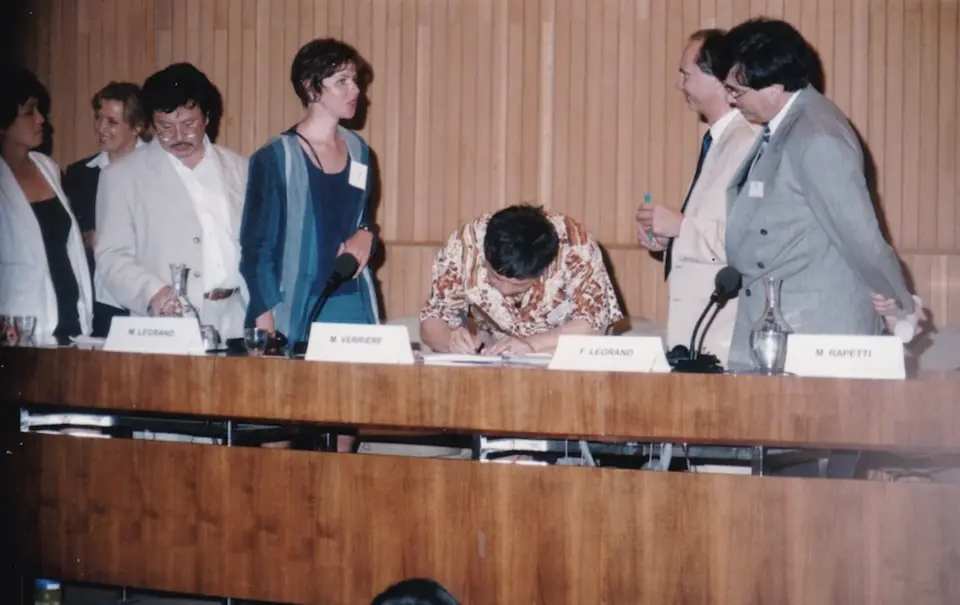
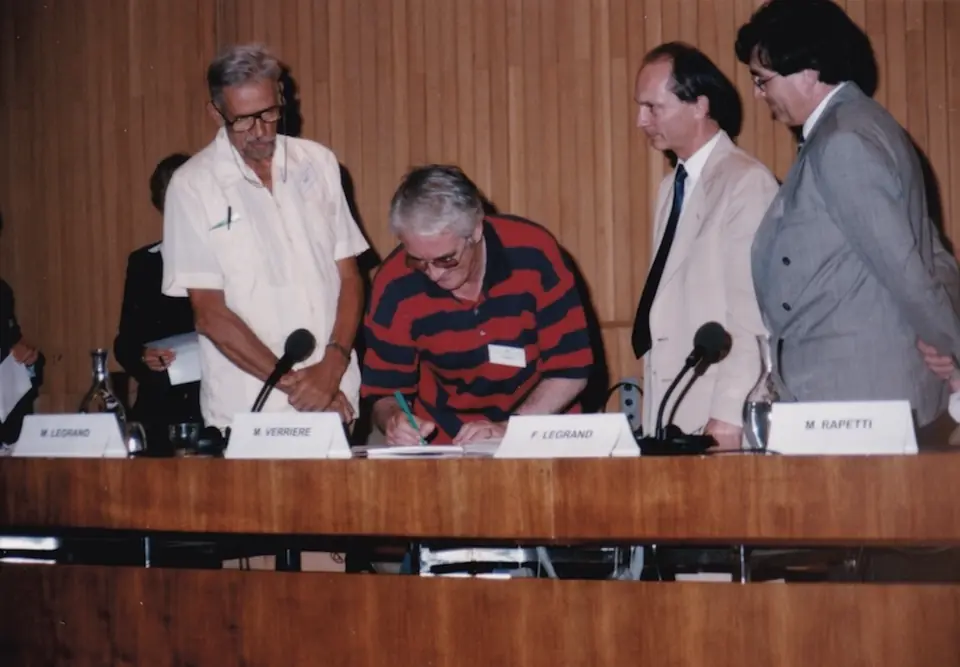
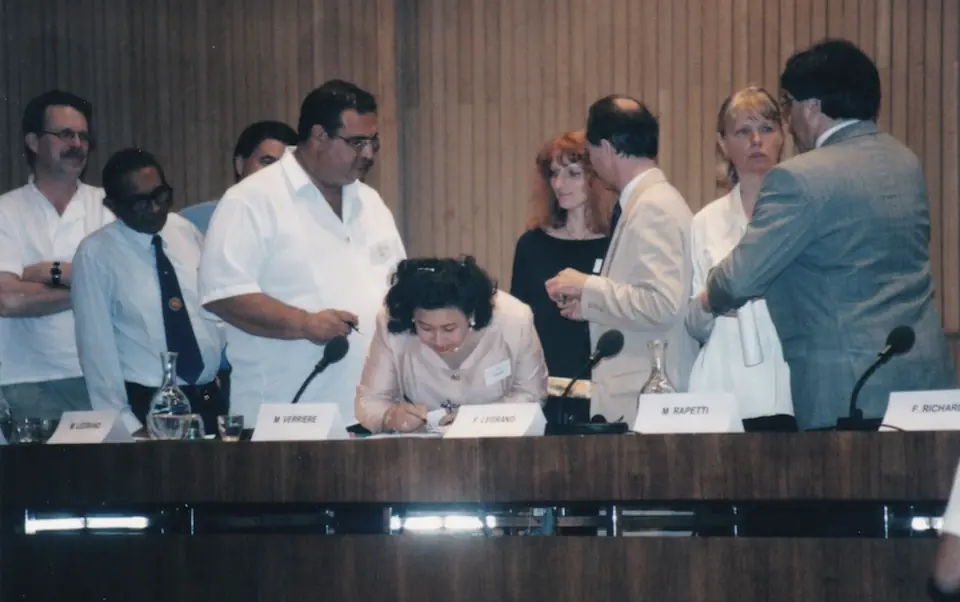
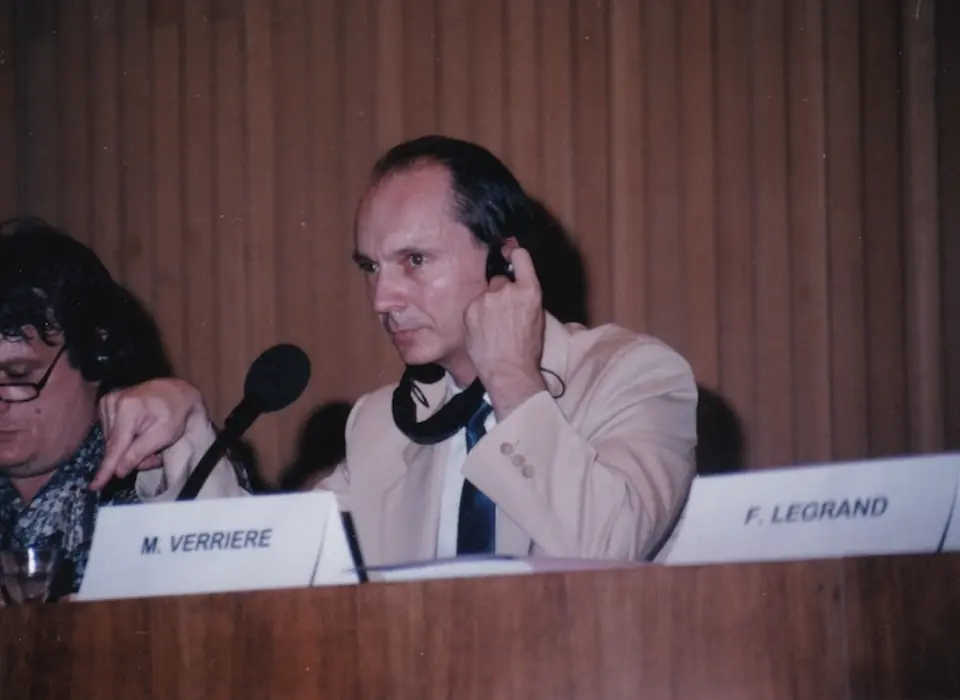
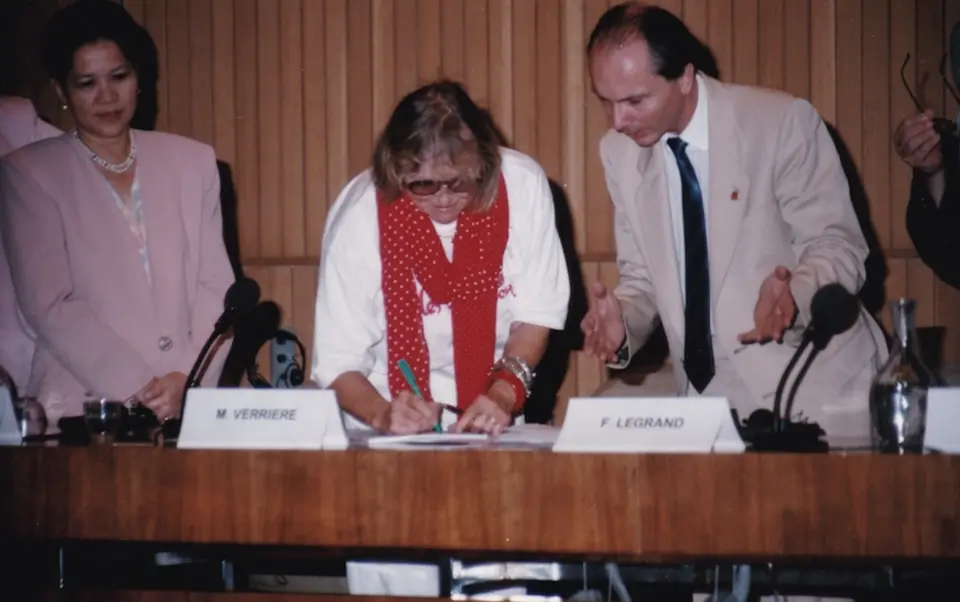
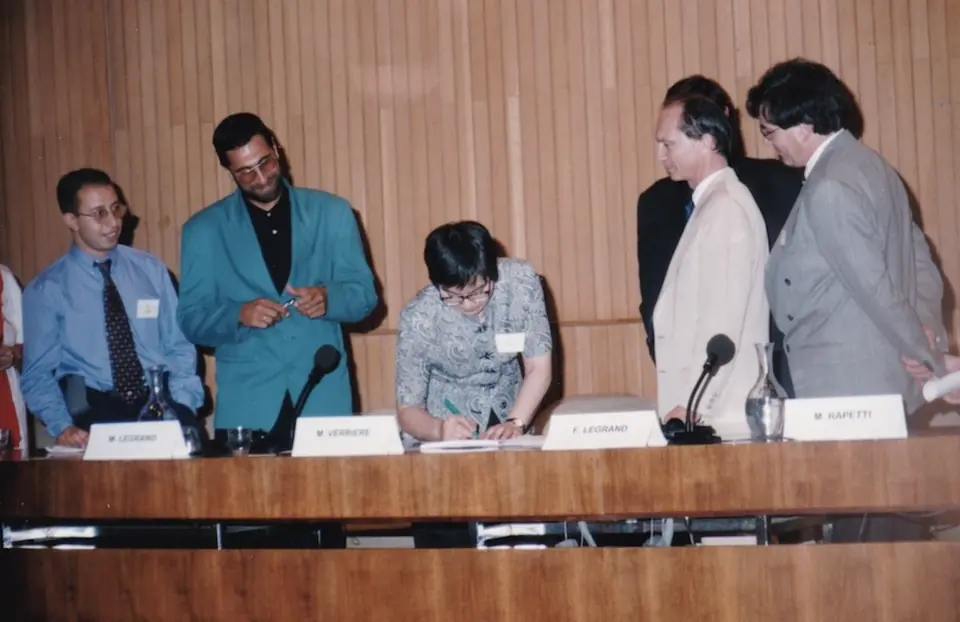
On 10 and 11 July 1995, cultural figures met at UNESCO in Paris at the invitation of Marc Verrière. They signed the first Olympic Arts Charter: the modern Olympic Arts were officially established. Six countries that could not attend approved the Charter in writing.
 (enlarge image, opens in a new tab)
 (enlarge image, opens in a new tab)
 (enlarge image, opens in a new tab)
 (enlarge image, opens in a new tab)
 (enlarge image, opens in a new tab)
 (enlarge image, opens in a new tab)
Charter signing sessions, UNESCO, July 1995.
The signatories, 65 countries
59 signatories were present. Six other countries that could not attend had already approved the Charter: Belgium, El Salvador, Ghana, Lebanon, Malaysia and the United Kingdom.
See the 59 signatories, country by country
| Country | Signatory | Position in 1995 |
|---|---|---|
| Algeria | Samir Mehalla | Professional musician |
| Argentina | Carmen Perez del Viso | Producer, delegate in charge of the CulturSur programme at UNESCO |
| Australia | Peter Jones | Registered architect, member of the Royal Australian Institute of Architects |
| Austria | Anne-Marie Zangerle | Professional musician, member of the World Philharmonic Orchestra |
| Bolivia | Walther Rico-Frontaura | Cultural affairs officer, Embassy of Bolivia |
| Brazil | Marlos Nobre | Former Secretary General of the International Music Council (IMC) at UNESCO |
| Canada | Alain Nonat | Artistic producer, director of the Théâtre Lyrichoregra, Quebec |
| Chile | Octavio Hasbun Rojas | Vice-President of the Chilean Music Council |
| China | Han Suyin | Honorary member of the CIAO and spokesperson for the Olympic Arts in China |
| Colombia | Pablo Gabriel Obregon | Ambassador, Permanent Delegate of Colombia to UNESCO |
| Croatia | Bojan Lhotka | Member of the Zagreb Philharmonic (Zagrebačka filharmonija) |
| Cuba | Ramiro Guerra | Director of the Dance Development Centre, Havana |
| Côte d’Ivoire | Adépo Yapo | Regional officer, International Music Council at UNESCO |
| Denmark | Pia Lauridsen | Artist and independent manager |
| Ecuador | Alvaro Manzano | Director of the Orquesta Sinfónica Nacional del Ecuador |
| Egypt | Dr Nasser El Ansary | President of the National Cultural Centre “Cairo Opera House” |
| Finland | Kimmo Pasanen | Director of the Finnish Cultural Institute in Paris |
| France | Jacques Prothin | Artistic producer, creator of Concordanse |
| Gabon | Léon-Paul Onanga-Azozet | Director General of ANPAC, ministry official |
| Germany | Bernd Schaller | Choir conductor, professional musician |
| Greece | Demis Visvikis | Composer, accredited musicologist |
| Grenada | Dr Alister Hughes | Writer and journalist, former Governor-General |
| Hong Kong | Lo King-man | Director of the Hong Kong Academy for Performing Arts |
| India | Shireen Isal | Producer, choreographer and renowned dancer in India |
| Iran | Gohar-Tadj Rastine | Independent artist |
| Iraq | Sultan Alkhatib | Professional musician, producer at Iraqi radio and television |
| Ireland | Derry O’Sullivan | Producer |
| Israel | Shifra Shalit-Intrator | Cultural adviser, Embassy of Israel |
| Italy | Massimo Riposati | Publisher, writer |
| Japan | Hitaumi Harigaya | Professional artist (sculptor) |
| Jordan | Nabeel Koni | Professional artist |
| Kazakhstan | J. Serik Sagidullinovich | Vice-President of the National Film Company of Kazakhstan |
| Lithuania | Ruta Pruseviciene | Head of external relations, culture |
| Mauritius | Choonee | Minister of Arts, Culture and Youth Development |
| Morocco | Chafik Bourquia | Producer, official at the Ministry of Culture |
| Netherlands | Ans Hey | Professional artist (sculptor) |
| New Zealand | Marie Angelino | Head of arts and cultural associations |
| Pakistan | Kishwar Naheed | Director of the Pakistan National Council of the Arts |
| Panama | Eduardo Charpentier | Conductor |
| Peru | Alida de Ribeyro | Artistic agent, visual arts specialist |
| Philippines | Carmen D. Padilla | Executive Director of the National Commission for Culture and the Arts |
| Poland | Ewa Osinska | President of the Association of Polish Musicians |
| Portugal | Luis de Sande Freire | Publisher, President of AIDEC in Portugal |
| Romania | Nicolae Bica | Choir conductor, head of music in Brașov |
| Russia | Igor Livant | Director of the “School of Peace” cultural centre, Irkutsk |
| Slovakia | Jurovska | Cultural adviser, Embassy of Slovakia |
| South Africa | W. A. C. Van Jaarsveld | Culture adviser, Johannesburg City Council |
| South Korea | Seong Chang Cho | Director of the Korean Embassy’s cultural centre |
| Spain | Catherine de Gil Casares | Independent producer |
| Sri Lanka | Cedric de Silva | Founder of the George Keyt Foundation |
| Sweden | Ragnar Hakanson | Musician, choir conductor |
| Switzerland | Richard Bächi-Schaefer | Director of the Tonhalle-Orchester, President of the European Union of Symphony Orchestras |
| Thailand | Pikulkaew Krairiksh | Chair of the Board, Bangkok Symphony Orchestra |
| Trinidad and Tobago | Cecil V. Rogers | President of the Arts Support Alliance |
| Tunisia | Farid Haffani | Producer, artist |
| Turkey | Emin Mahir Balcioglu | Registered architect, government official |
| Uganda | Prof. Mbabi Katana | University professor and government representative |
| United States | Christian Erickson | Stage actor |
| Vietnam | Nguyen Can Ruyen | First Secretary, Embassy of Vietnam |
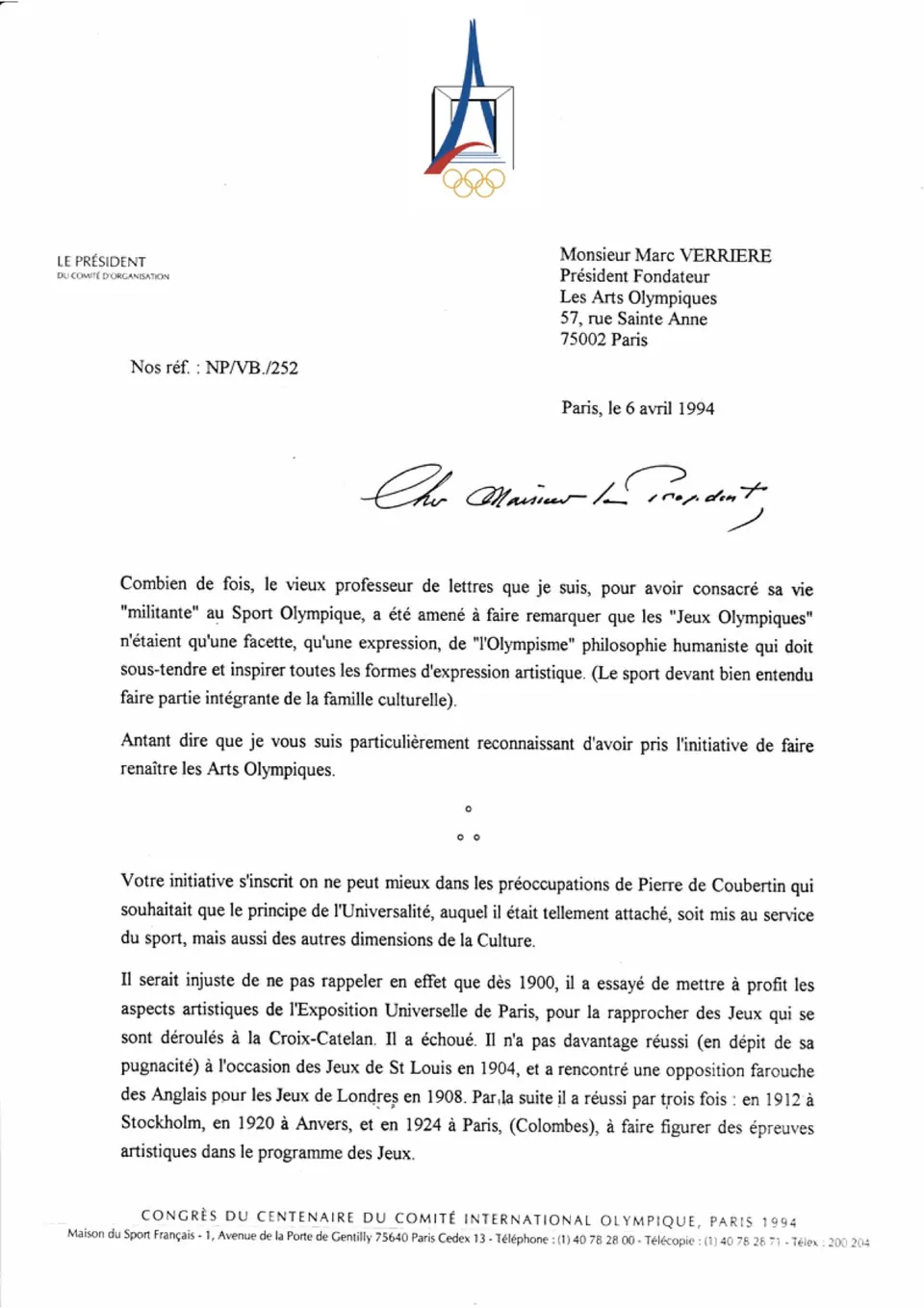
Nelson Paillou’s letter, 6 April 1994
Nelson Paillou (1924-1997), President of the French National Olympic and Sports Committee from 1982 to 1993 and President of the Centennial Congress of the International Olympic Committee – Paris 1994. He wrote to Marc Verrière a year before the Charter was signed.
“I am particularly grateful to you for taking the initiative to revive the Olympic Arts”
“I fully support your charter, and the arrangements you are making to set up the first of these Games in 1995”
— Nelson Paillou, Honorary President of the CNOSF, President of the Organising Committee of the Centennial Congress, letter to Marc Verrière, 6 April 1994. Translated from French.
 (enlarge image, opens in a new tab)
Letter from Nelson Paillou to Marc Verrière, 6 April 1994, page 1 of 3. Marc Verrière archives. 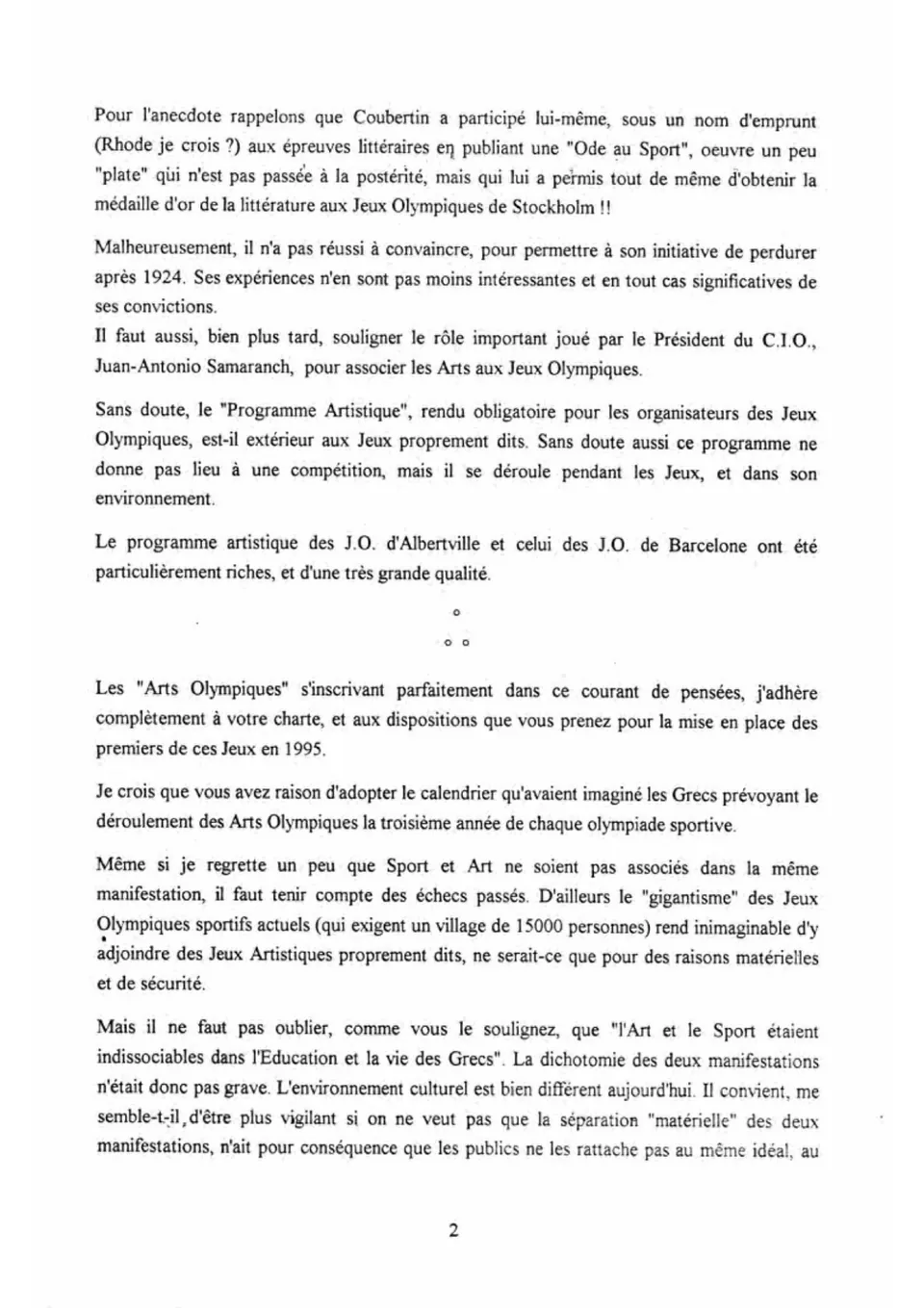 (enlarge image, opens in a new tab)
Letter from Nelson Paillou to Marc Verrière, 6 April 1994, page 2 of 3. Marc Verrière archives. 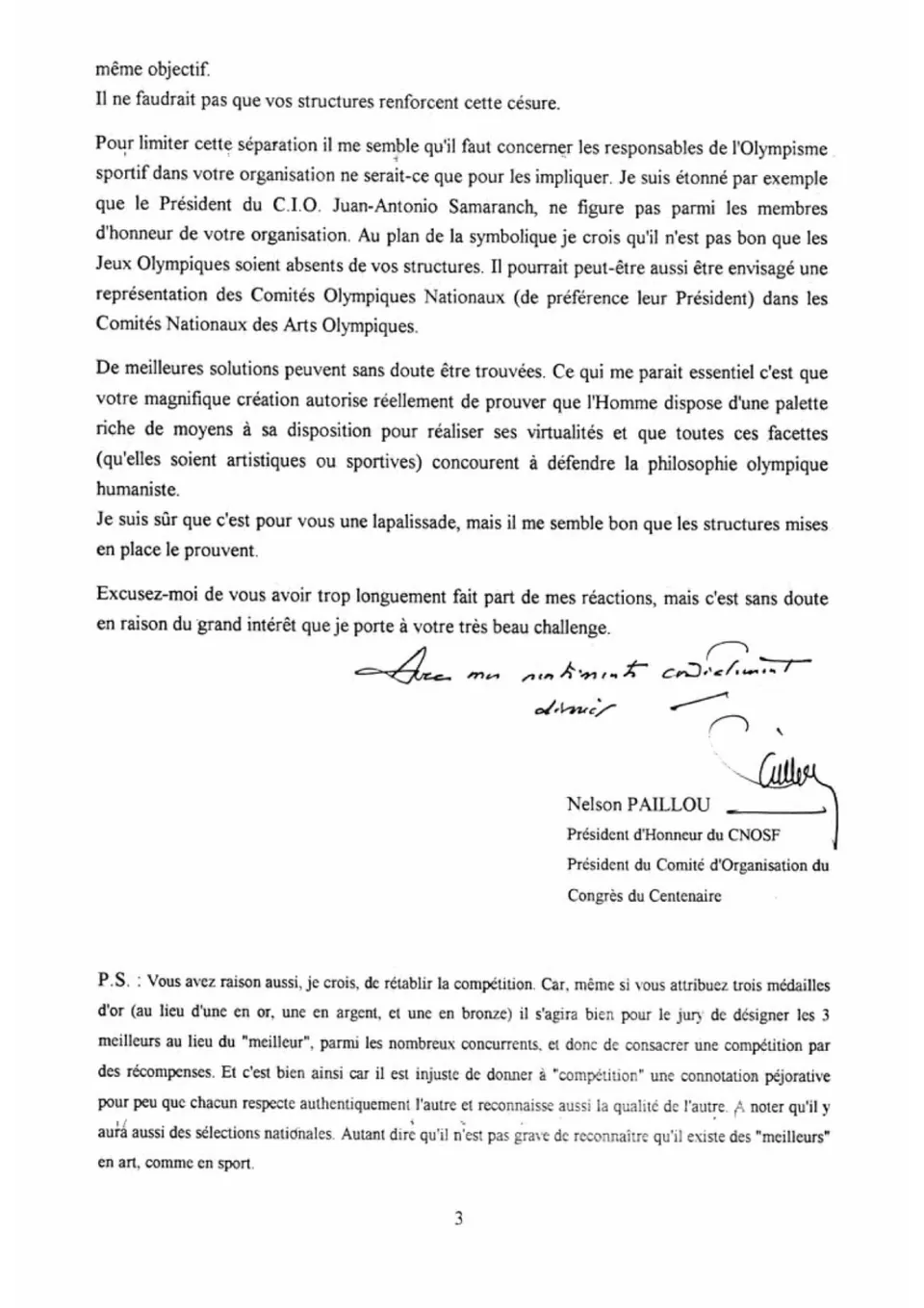 (enlarge image, opens in a new tab)
Letter from Nelson Paillou to Marc Verrière, 6 April 1994, page 3 of 3. Marc Verrière archives.
Read the full transcription of the letter (in French, 3 pages)
[En-tête : Le Président du Comité d’organisation — Congrès du centenaire du Comité international olympique, Paris 1994.]
Nos réf. : NP/VB./252 — Paris, le 6 avril 1994
Cher Monsieur le Président,
Combien de fois, le vieux professeur de lettres que je suis, pour avoir consacré sa vie « militante » au Sport Olympique, a été amené à faire remarquer que les « Jeux Olympiques » n’étaient qu’une facette, qu’une expression, de « l’Olympisme », philosophie humaniste qui doit sous-tendre et inspirer toutes les formes d’expression artistique. (Le sport devant bien entendu faire partie intégrante de la famille culturelle).
Autant dire que je vous suis particulièrement reconnaissant d’avoir pris l’initiative de faire renaître les Arts Olympiques.
Votre initiative s’inscrit on ne peut mieux dans les préoccupations de Pierre de Coubertin qui souhaitait que le principe de l’Universalité, auquel il était tellement attaché, soit mis au service du sport, mais aussi des autres dimensions de la Culture.
Il serait injuste de ne pas rappeler en effet que dès 1900, il a essayé de mettre à profit les aspects artistiques de l’Exposition universelle de Paris, pour la rapprocher des Jeux qui se sont déroulés à la Croix-Catelan. Il a échoué. Il n’a pas davantage réussi (en dépit de sa pugnacité) à l’occasion des Jeux de St Louis en 1904, et a rencontré une opposition farouche des Anglais pour les Jeux de Londres en 1908. Par la suite il a réussi par trois fois : en 1912 à Stockholm, en 1920 à Anvers, et en 1924 à Paris (Colombes), à faire figurer des épreuves artistiques dans le programme des Jeux.
Pour l’anecdote rappelons que Coubertin a participé lui-même, sous un nom d’emprunt (Rhode je crois ?) aux épreuves littéraires en publiant une « Ode au Sport », œuvre un peu « plate » qui n’est pas passée à la postérité, mais qui lui a permis tout de même d’obtenir la médaille d’or de la littérature aux Jeux Olympiques de Stockholm !!
Malheureusement, il n’a pas réussi à convaincre, pour permettre à son initiative de perdurer après 1924. Ses expériences n’en sont pas moins intéressantes et en tout cas significatives de ses convictions.
Il faut aussi, bien plus tard, souligner le rôle important joué par le Président du C.I.O., Juan-Antonio Samaranch, pour associer les Arts aux Jeux Olympiques.
Sans doute, le « Programme Artistique », rendu obligatoire pour les organisateurs des Jeux Olympiques, est-il extérieur aux Jeux proprement dits. Sans doute aussi ce programme ne donne pas lieu à une compétition, mais il se déroule pendant les Jeux, et dans son environnement.
Le programme artistique des J.O. d’Albertville et celui des J.O. de Barcelone ont été particulièrement riches, et d’une très grande qualité.
Les « Arts Olympiques » s’inscrivant parfaitement dans ce courant de pensées, j’adhère complètement à votre charte, et aux dispositions que vous prenez pour la mise en place des premiers de ces Jeux en 1995.
Je crois que vous avez raison d’adopter le calendrier qu’avaient imaginé les Grecs prévoyant le déroulement des Arts Olympiques la troisième année de chaque olympiade sportive.
Même si je regrette un peu que Sport et Art ne soient pas associés dans la même manifestation, il faut tenir compte des échecs passés. D’ailleurs le « gigantisme » des Jeux Olympiques sportifs actuels (qui exigent un village de 15 000 personnes) rend inimaginable d’y adjoindre des Jeux Artistiques proprement dits, ne serait-ce que pour des raisons matérielles et de sécurité.
Mais il ne faut pas oublier, comme vous le soulignez, que « l’Art et le Sport étaient indissociables dans l’Éducation et la vie des Grecs ». La dichotomie des deux manifestations n’était donc pas grave. L’environnement culturel est bien différent aujourd’hui. Il convient, me semble-t-il, d’être plus vigilant si on ne veut pas que la séparation « matérielle » des deux manifestations n’ait pour conséquence que les publics ne les rattachent pas au même idéal, au même objectif.
Il ne faudrait pas que vos structures renforcent cette césure.
Pour limiter cette séparation il me semble qu’il faut concerner les responsables de l’Olympisme sportif dans votre organisation ne serait-ce que pour les impliquer. Je suis étonné par exemple que le Président du C.I.O. Juan-Antonio Samaranch ne figure pas parmi les membres d’honneur de votre organisation. Au plan de la symbolique je crois qu’il n’est pas bon que les Jeux Olympiques soient absents de vos structures. Il pourrait peut-être aussi être envisagé une représentation des Comités Olympiques Nationaux (de préférence leur Président) dans les Comités Nationaux des Arts Olympiques.
De meilleures solutions peuvent sans doute être trouvées. Ce qui me paraît essentiel c’est que votre magnifique création autorise réellement de prouver que l’Homme dispose d’une palette riche de moyens à sa disposition pour réaliser ses virtualités et que toutes ces facettes (qu’elles soient artistiques ou sportives) concourent à défendre la philosophie olympique humaniste.
Je suis sûr que c’est pour vous une lapalissade, mais il me semble bon que les structures mises en place le prouvent.
Excusez-moi de vous avoir trop longuement fait part de mes réactions, mais c’est sans doute en raison du grand intérêt que je porte à votre très beau challenge.
Avec mes sentiments cordialement dévoués
Nelson PAILLOU
Président d’Honneur du CNOSF
Président du Comité d’Organisation du Congrès du Centenaire
P.S. : Vous avez raison aussi, je crois, de rétablir la compétition. Car, même si vous attribuez trois médailles d’or (au lieu d’une en or, une en argent, et une en bronze) il s’agira bien pour le jury de désigner les 3 meilleurs au lieu du « meilleur », parmi les nombreux concurrents, et donc de consacrer une compétition par des récompenses. Et c’est bien ainsi car il est injuste de donner à « compétition » une connotation péjorative pour peu que chacun respecte authentiquement l’autre et reconnaisse aussi la qualité de l’autre. À noter qu’il y aura aussi des sélections nationales. Autant dire qu’il n’est pas grave de reconnaître qu’il existe des « meilleurs » en art, comme en sport.
Niki de Saint Phalle’s note, 1995
In 1995, at the time the Charter was signed, the artist Niki de Saint Phalle sent Marc Verrière a handwritten note, decorated with one of her drawings, to thank him for the invitation to join the Olympic Arts.
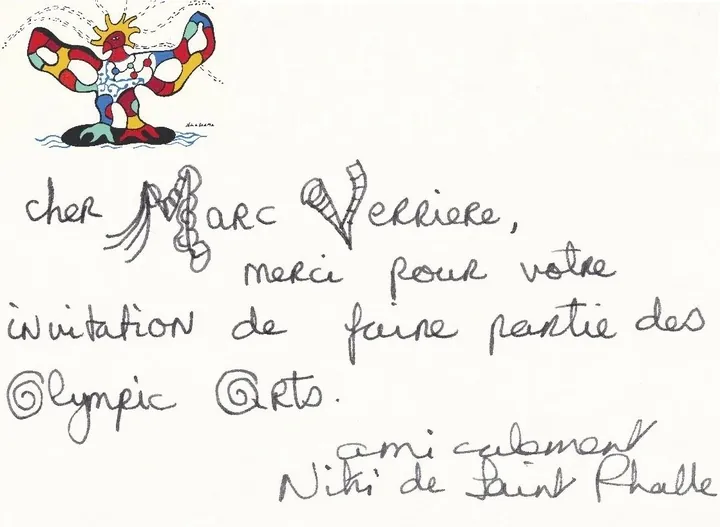 (enlarge image, opens in a new tab)
“Dear Marc Verrière,
thank you for your invitation to be part of the Olympic Arts.Best wishes,
Niki de Saint Phalle”
Translated from French.
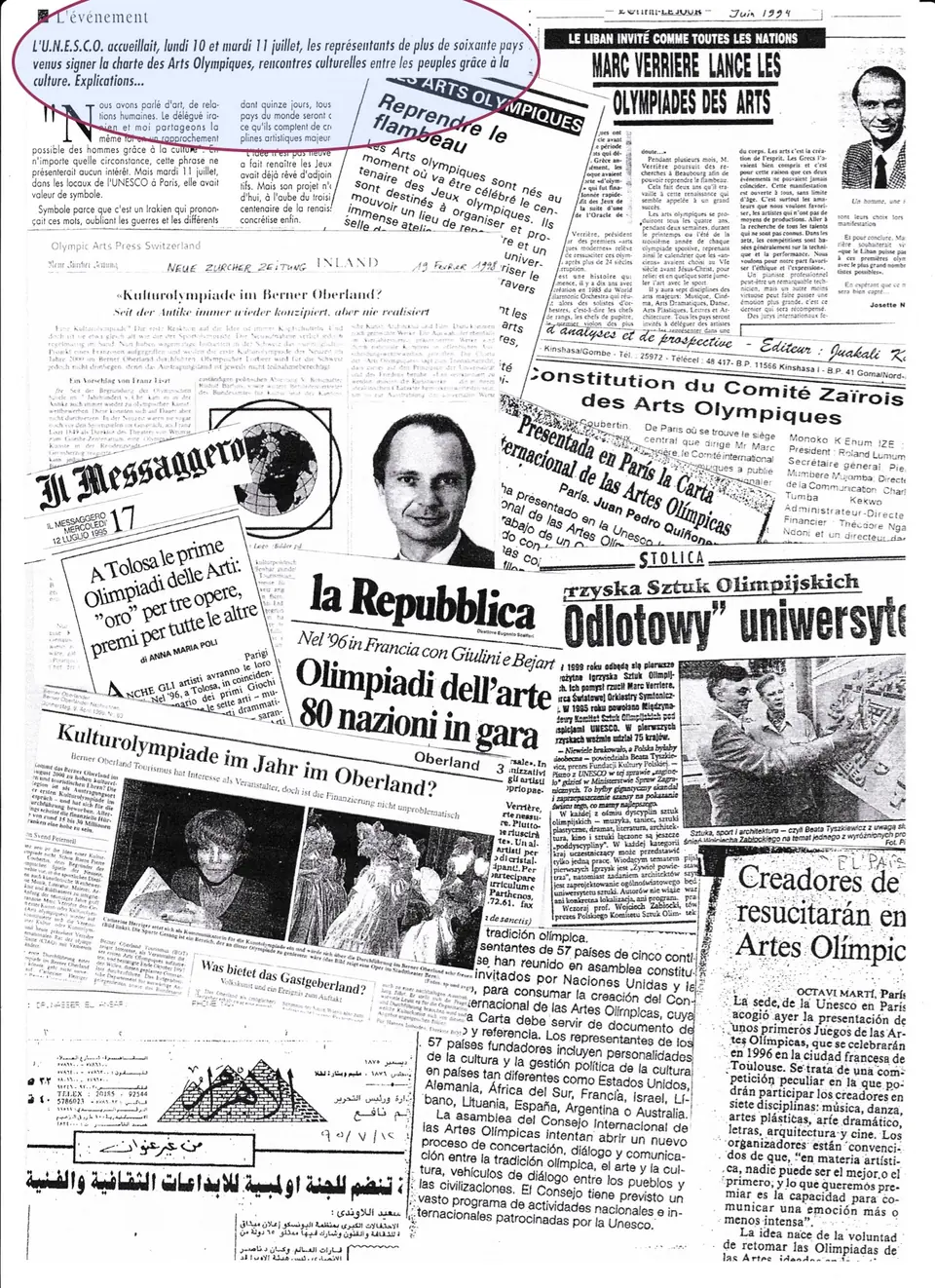
The press at the time
The creation of the Olympic Arts was covered in many press articles.
 (enlarge image, opens in a new tab)
Sources
- List of signatories, 1995, Marc Verrière archives.
- Letter from Nelson Paillou to Marc Verrière, 6 April 1994, Marc Verrière archives.
- Press clippings, 1994-1998, Marc Verrière archives.
- Biography of Nelson Paillou: Wikipedia (in French) (external site, opens in a new tab) and Olympedia (external site, opens in a new tab).